






.jpg)
.svg)
Two live murder trials on either side of the Irish Sea have placed an uncomfortable question before the public: why, in rare but deeply troubling cases, do women stand accused of killing other women in disputes rooted in romantic rivalry? At Leeds Crown Court in England, Kayla Smith, 18, has pleaded guilty to the murder of 16-year-old Chloe Watson Dransfield after a pre-planned fight over a boyfriend. At the Central Criminal Court in Dublin, a 41-year-old woman denies the murder of 28-year-old Scarlett Faulkner at Birdhill, County Tipperary, in a case the prosecution alleges involved a 24-hour joint-enterprise pursuit driven by jealousy over her estranged husband's new relationship. Daily Dazzling Dawn understands both cases are still before the courts, that contested allegations remain unproven, and that the two jurisdictions operate under separate legal systems and separate reporting restrictions.
Kayla Smith changed her plea to guilty on the second day of her trial at Leeds Crown Court on Thursday, 12 November 2026, having initially admitted manslaughter but denied murder. Mr Justice Cavanagh KC warned her that the only sentence available for murder is life imprisonment, though he will determine the minimum term she must serve before release. Daily Dazzling Dawn learned that the prosecution, led by Mark McKone KC, described a dispute fuelled by jealousy over 18-year-old Blake Dowling, who had been in an on-off relationship with both Smith and the victim. The jury heard evidence that Smith was described as "jealous and obsessed" with Dowling's relationship with Chloe.
The court was told the two girls had argued the previous evening, during which Smith threatened to stab her. A friend of Chloe, on a FaceTime call at the time, heard Smith screaming threats before stating: "I'm gonna stab you in your throat." The two girls then agreed to fight, and Dowling booked a taxi to take Chloe to the home of Smith's grandfather in Austhorpe, east Leeds. CCTV and doorbell footage showed Smith emerging from a garden annexe holding a knife and shouting: "Come on big girl." Chloe Watson Dransfield was stabbed five times in the neck and back and died at the scene on Kennerleigh Avenue on Saturday, 28 March 2026.
A Home Office forensic pathologist, Dr Robert Ainsworth, told the jury the fatal wound measured approximately 13cm from skin surface to end point, and that because it had not damaged the heart, aorta or a central pulmonary artery, the timeframe for significant blood loss may have been longer than in other cases. The trial continues for Blake Dowling, 18, and Archie Rycroft, 20, who both deny murder and manslaughter. The prosecution alleges Dowling organised the violence by booking the taxi, and that Rycroft supported Smith by walking with her and attempting to film the fight. Neither co-defendant has been convicted of any offence, and Daily Dazzling Dawn emphasises that all allegations against them are contested.
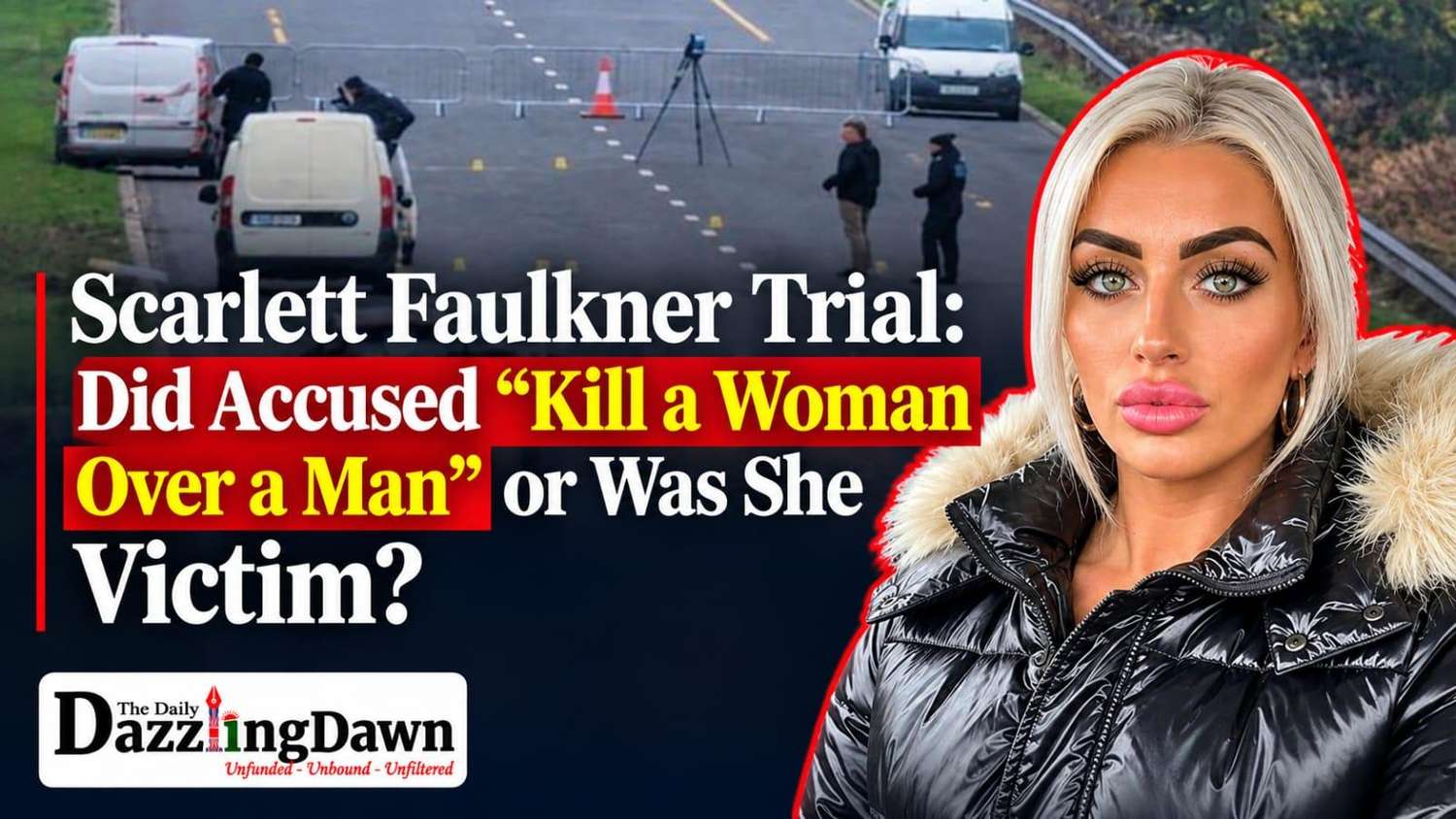
At the Central Criminal Court in Dublin, a 41-year-old woman denies murdering Scarlett Faulkner, a 28-year-old mother from Limerick who died in hospital on 13 April 2026, three weeks after an incident near the Birdhill roundabout off the M7. Neither the accused, her estranged husband, nor her 17-year-old co-defendant can be named because of reporting restrictions. The prosecution, led by Seoirse Ó Dúnlaing SC, alleges the two accused acted in a joint enterprise to kill or cause serious harm to Ms Faulkner and the older woman's husband, having allegedly pursued them for roughly 24 hours before ramming their van.
Ellie Bellie's Last Goodbye: Waterford Mourns Arson Victim As Funeral Demands Murder Justice
The jury has watched Garda interview recordings in which the 41-year-old said she "didn't lay a finger on that girl" and blamed her husband, alleging he emerged from his van with a hatchet and threatened to "cut her head off." She described her marriage as being in terminal decline and said she was devastated when he left her for another woman. In a voice note played to the jury, the 17-year-old co-defendant described striking Ms Faulkner with an iron bar. The teenager has pleaded not guilty to murder and guilty to manslaughter. Daily Dazzling Dawn understands all of this material has been presented as evidence before the jury and does not constitute findings of fact. The trial continues before Mr Justice Kerida Naidoo.
The urge to explain such cases through established research is understandable, but the fit is imperfect. Dr Jane Monckton Smith of the University of Gloucestershire identified an eight-stage "homicide timeline" across 372 UK killings, published in the journal Violence Against Women. Her model traces a path from a pre-relationship history of stalking or abuse, through rapid attachment and coercive control, to a trigger, escalation, a change in thinking, planning and homicide. She told the BBC that the "crime of passion, spontaneous red-mist" explanation is "just not true," adding: "If you start looking at all these cases, there's planning, determination, there's always coercive control."
Crucially, however, Dr Monckton Smith's model was developed principally around intimate partner homicide, in which the perpetrator kills a current or former partner. It was not designed to explain third-party killings between romantic rivals. Daily Dazzling Dawn notes that it can be applied here only as a broader lens on coercive control and premeditation, not as direct empirical proof of a pattern in love-rival homicides.
Similarly, research by the Centre for Women's Justice, published in October 2021, examined women who kill abusive intimate partners rather than women who kill rivals. That study found evidence of abuse in 77 per cent of a subset of 108 cases where men were killed by female partners or ex-partners over a decade, compared with 840 women killed by male partners or ex-partners in the same period. Just six per cent of cases studied resulted in acquittal on self-defence grounds. Sophie Howes, a research consultant at the charity, wrote that when women kill, "it is often because of failings in the very system that is supposed to protect them." Those findings illuminate the justice system's treatment of abused women who kill their abusers; they do not describe the dynamic now before the courts in Leeds and Dublin, and Daily Dazzling Dawn draws the distinction deliberately.
Claims of a rising trend in women killing women over a man are not supported by the evidence currently available. The Home Office's Homicide Index and the Office for National Statistics' homicide datasets record victim and suspect sex, but do not code motive in a way that isolates romantic-rival killings between women. Police crime-recording systems such as the Metropolitan Police's CRIS database, queried through SAP BusinessObjects BI, capture suspect sex and victim sex but likewise cannot substantiate a love-rival trend. Any figure purporting to show such an increase should be treated with caution until verified against ONS homicide data or a documented freedom of information disclosure. Daily Dazzling Dawn has not identified a verified statistical basis for a rise.
Stripped of unproven theories, the two prosecutions share certain alleged features: premeditation, sustained hostility before the fatal incident, and a romantic relationship at the centre of the dispute. In Leeds, the Crown alleges threats were made the night before and a fight was arranged. In Dublin, the State alleges a pursuit lasting around 24 hours. Both are contested. What the cases do not yet offer is a general explanation for female-perpetrated lethal violence against other women. Each will turn on its own evidence, and each jury must be guided by the law rather than by criminological generalisation. Daily Dazzling Dawn will report the verdicts as they are delivered.




.jpg)
.jpg)
.jpg)