






.svg)
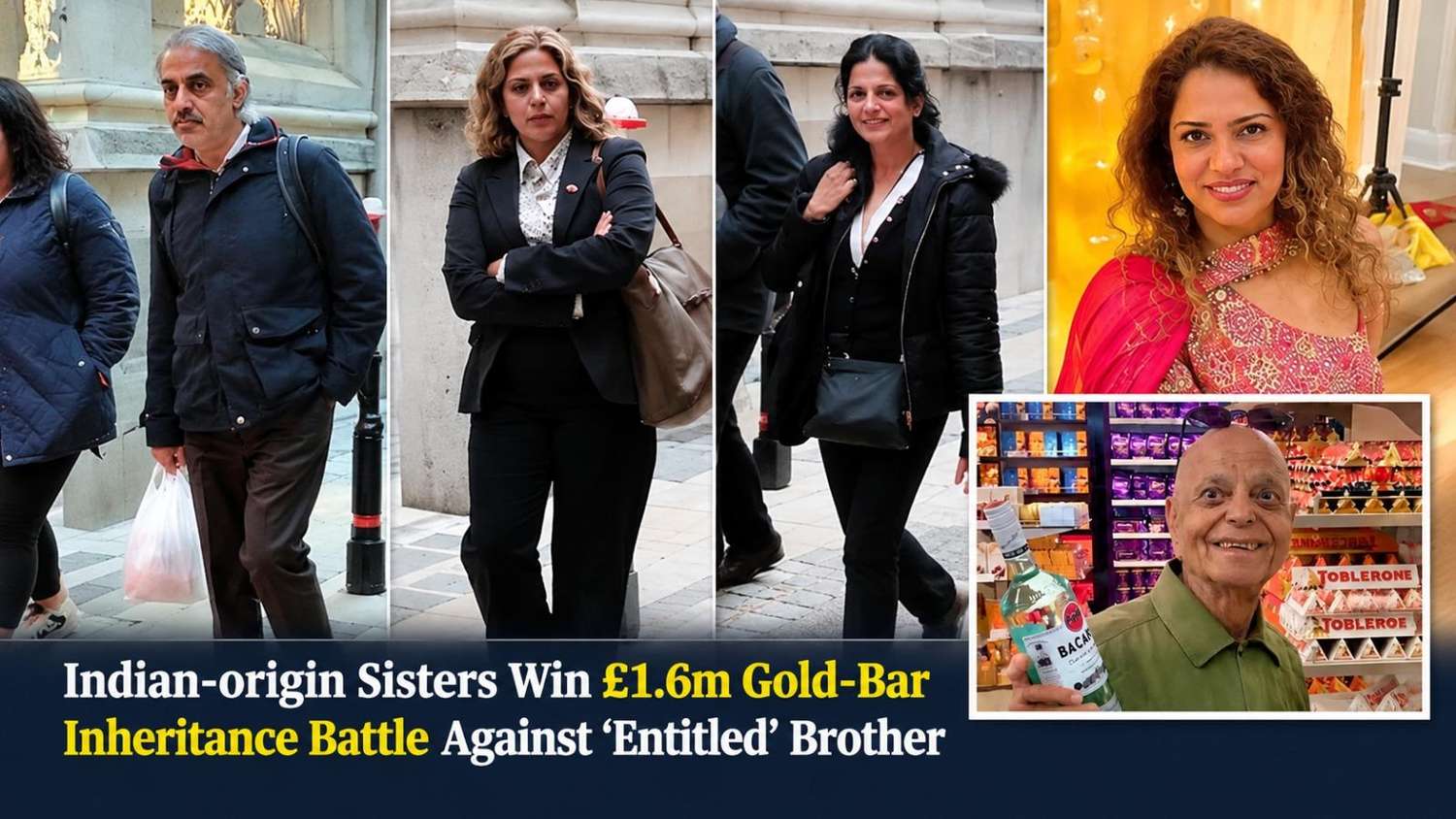
Three British-Indian sisters have won a £1.6 million inheritance battle against their "entitled" brother after a London court ruled that a £300,000 savings account and a safety deposit box of gold bars and jewellery must be shared equally among the four siblings. Airan Grover-Jones, Kiran Cotterell and Kelly Puri sued their brother, Sonny Grover, at the Mayor's and City County Court in London over the estate of their father, Hari Grover, who died without a will in September 2024, aged 85.
Hari Grover, a retired businessman of Indian origin who lived in Ealing, west London, left an estate in England valued for probate at around £865,000, including his house. A separate stash of gold bars and jewellery, held in a safety deposit box in India, is estimated to be worth up to £500,000. Because he died intestate, his only son, Sonny, was appointed administrator and, according to his sisters, was told to "look after" them by dividing the fortune equally.
Isobella Perrie Sullivan: Law Student, 25, Faces Special Criminal Court Over Border Explosives
The sisters argued that the true value of their father's English estate was closer to £1.15 million. Their claim centred on a £300,000 life savings account held in Hari's name, which Sonny insisted had passed to him by survivorship after their father made him a joint beneficial holder at a bank branch eight years before his death. Daily Dazzling Dawn understands the family initially co-operated after the death but fell out while completing inheritance tax forms, after which Sonny took "unilateral" steps to deal with the estate.
Judge Nicholas Parfitt rejected Sonny's claim outright. "It is the court, not the bank, that decides this dispute, surprisingly enough," he said, finding that no funds in the account had come from Sonny's own assets. Evidence that Hari kept his passbook "secret" and hidden showed the father "kept this account to himself" and did not involve his son, the judge concluded. The £300,000 therefore belongs to the estate and will be split with his sisters.
Sonny also claimed the gold and jewellery in the Indian safety deposit box had been gifted to him in 2017, along with control of the lock-up. The court heard that Hari told his daughters as he faced death: "Don't worry, you can trust your brother, he will share things equally." Judge Parfitt ruled that Hari had "entrusted the box to Mr Grover rather than gifted it", meaning Sonny and his wife hold the contents on trust for the whole family. Sonny must now provide a full account of what the box contained when he took control of it in 2017.
In a sharply worded ruling, Judge Parfitt described Sonny as "an extremely poor witness because he was simply constantly argumentative". He said Sonny had developed "a sense of entitlement, a sense of preference, a sense of desert" after living with his father in his final years, believing he and his wife had "acted like angels towards his father". The judge added that Sonny "believes that a just result in this case is one which would see him getting everything and his sisters getting nothing, because that's what he deserves".
Despite the criticism, Judge Parfitt accepted there was "no criticism of the work done [by Sonny] on the estate outside of the relevant items... he has done a good job". He ordered Sonny to pay his sisters' £80,000 legal bill but declined their bid to remove him as administrator immediately, granting him six more months to resolve remaining issues. "They need to put their big person pants on and get it sorted out," the judge told the siblings. An application for a payment on account of costs was stayed for six months.
The case highlights the legal dangers of dying intestate, particularly for families with assets in multiple countries. With no will in place, Hari Grover's fortune falls under UK intestacy rules — a process that has now cost the family heavily in legal fees and divided the siblings. The judge left the family to decide whether the gold collection should be broken up and distributed to the next generation or whether specific items should be kept by their rightful owners, giving the four siblings a final chance to settle privately.