






.svg)
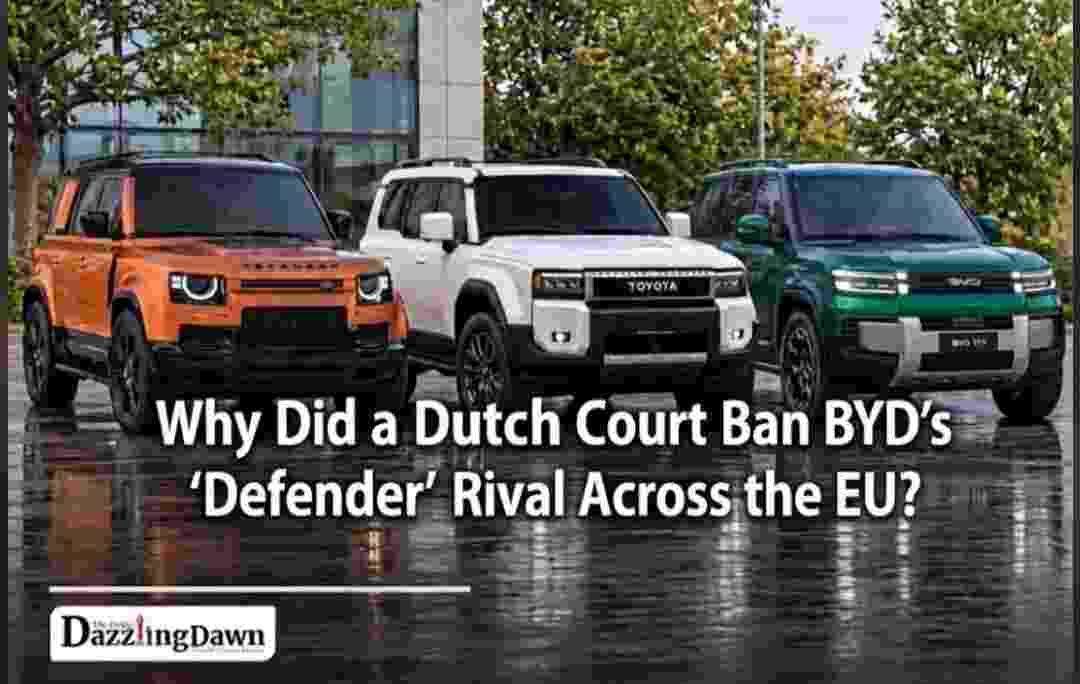
The District Court of The Hague has banned Chinese automotive giant BYD from importing, manufacturing, advertising, or selling its Ti7 sport utility vehicle across all 27 European Union member states after ruling on 20 November 2026 that the model infringes the registered design rights of the Land Rover Defender. Granted by preliminary relief judge J.B.J. Hoefnagel following an urgent intellectual property claim brought by Tata Motors-owned Jaguar Land Rover (JLR), the injunction takes effect one week after service and is backed by penalty payments of up to €10 million. Crucially, the sweeping continental prohibition stops short of the United Kingdom, where the court ruled it lacked legal jurisdiction over BYD’s British subsidiary—leaving the £47,995 seven-seat plug-in hybrid on course for UK customer deliveries in January 2027 while EU trade and planned Hungarian production grind to a halt.
Anatomy of the Design Infringement Ruling- In handing down the interim decision under case reference C/09/712003 / KG ZA 26-956, the Hague court concluded that the overall visual impression produced by the BYD Ti7 fails to create a sufficiently distinct appearance from JLR’s registered EU design for the Defender L663 (design number 005248580-0004). Judges specifically cited the Chinese SUV’s flat-roof silhouette, upright proportions, squared-off wheel arches, distinct glasshouse styling, and the signature body-coloured panel behind the rear passenger door as mirroring protected aesthetic elements of the modern Defender, which JLR relaunched to global acclaim in 2020. Under European Union Community Design law, a vehicle’s exterior styling is protected if an informed user perceives no clear overall difference from an existing registered design.
While marketed internationally as the BYD Ti7, the model is retailed domestically in China as the Tai 7 under BYD’s rugged off-road sub-brand, Fangchengbao—which translates to Formula Leopard—where cumulative sales surpassed 309,000 units by October 2026. Unlike BYD’s pure battery-electric lineup that has rapidly gained European market share, the Ti7 is a seven-seat plug-in hybrid electric vehicle (PHEV) priced roughly £20,000 below the Defender to target the lucrative family adventure segment. Following the verdict, BYD issued a formal statement rejecting the court’s findings. A company spokesperson stated that the BYD Ti7 is the result of BYD's own independent design work and infringes none of JLR's rights, adding that the automaker will pursue every legal avenue to demonstrate that the decision is incorrect. Jaguar Land Rover welcomed the interim protection, noting in an official statement that the company protects its intellectual property and takes legal action when necessary while declining further comment on ongoing proceedings.
Hungarian Factory Ban, Six-Month Clock, and the UK Loophole- Beyond blocking showroom imports across the bloc, the Hague order explicitly prohibits BYD from assembling the Ti7 at its upcoming European manufacturing facility in Szeged, Hungary, which is scheduled to begin mass production in early 2027. Any breach of the injunction carries daily fines of €100,000, or €25,000 per vehicle, up to the €10 million ceiling. Because the 20 November ruling constitutes provisional relief rather than a final judgement on the merits, Article 1019i of the Dutch Code of Civil Procedure dictates that JLR must initiate full substantive legal proceedings within six months—by 20 May 2027—or BYD can apply to have the pan-European restrictions lifted.
Meanwhile, post-Brexit regulatory divergence has created a striking geographical anomaly across the English Channel. Because the United Kingdom operates outside the jurisdiction of the European Union’s intellectual property courts, the Dutch ruling carries zero legal weight in England, Scotland, Wales, or Northern Ireland. The court confirmed that BYD (U.K.) Co., Limited is not a subsidiary of BYD Europe and cannot be sued in the Netherlands over British commercial acts. Daily Dazzling Dawn understands that JLR would need to file separate litigation through the High Court in London before January 2027 if it intends to block British deliveries. Separately, a parallel lawsuit brought by JLR at the District Court of Rotterdam—alleging copyright infringement and slavish imitation—remains ongoing. While some online commentators have mistakenly linked Defender assembly to Slovenia, the current generation Land Rover Defender is actually built at JLR’s manufacturing plant in Nitra, Slovakia.
Motorists Question Design Lawsuits and Market Competition- News of the court-ordered sales halt has ignited fierce debate among automotive enthusiasts and everyday drivers, many of whom question whether styling similarities warrant restricting consumer choice in an increasingly homogenised global car market. Several motorists commenting on the ruling argued that modern crossovers and utility vehicles routinely share near-identical proportions, suggesting buyers care far more about cabin technology and reliability than exterior silhouettes. One driver remarked online that most modern vehicles look remarkably similar to one another, suggesting critics should instead examine the internals because the Chinese engineering may well surpass the British rival.
Other observers expressed confusion over why BYD adopted such familiar boxy cues when its own design studios have proven capable of original styling, pointing to the compact BYD Dolphin Surf as evidence of the brand's distinctive battery technology and fresh aesthetic direction. A section of the public also questioned the consistency of European design enforcement, asking why certain South Korean models from Hyundai, Kia, and Genesis have faced fewer legal hurdles despite bold styling evolution, while warning that the global market would enter a messy state if minor visual overlaps routinely triggered international sales bans.
More pointedly, several commentators framed the dispute as a symptom of wider industrial anxiety as legacy European marques confront fierce competition from Chinese clean-tech giants. Daily Dazzling Dawn learned that many industry watchers view the courtroom clash as a strategic distraction, with one observer arguing online that European carmakers are waging an unwinnable battle against rapidly evolving buyer preferences and rocket-paced technological shifts, urging traditional manufacturers to channel their energy into next-generation automotive innovation rather than litigation. Another motorist speculated that rather than attempting to copy British mechanical technology, BYD’s styling choices appeared to be a deliberate provocation aimed squarely at Land Rover as a rival corporate establishment.
Whats Next for JLR and BYD- For Jaguar Land Rover—which sold 29,500 Defenders globally between July and September 2026 alone and relies on the nameplate as one of its highest-margin profit pillars—the Hague injunction represents a decisive early victory in defending its brand equity, echoing its successful 2019 court battle against China’s Jiangling Motors over the Landwind X7. For BYD, the ruling complicates its broader European expansion strategy at a time when the Shenzhen-based giant is navigating EU import tariffs on battery-electric vehicles by pivoting toward plug-in hybrids like the Ti7. Both automakers now face a high-stakes window as BYD prepares its four-week appeal in the Netherlands and JLR weighs whether to launch a fresh intellectual property offensive in London before British showrooms open their doors in January.


.jpg)