.jpg)





.svg)
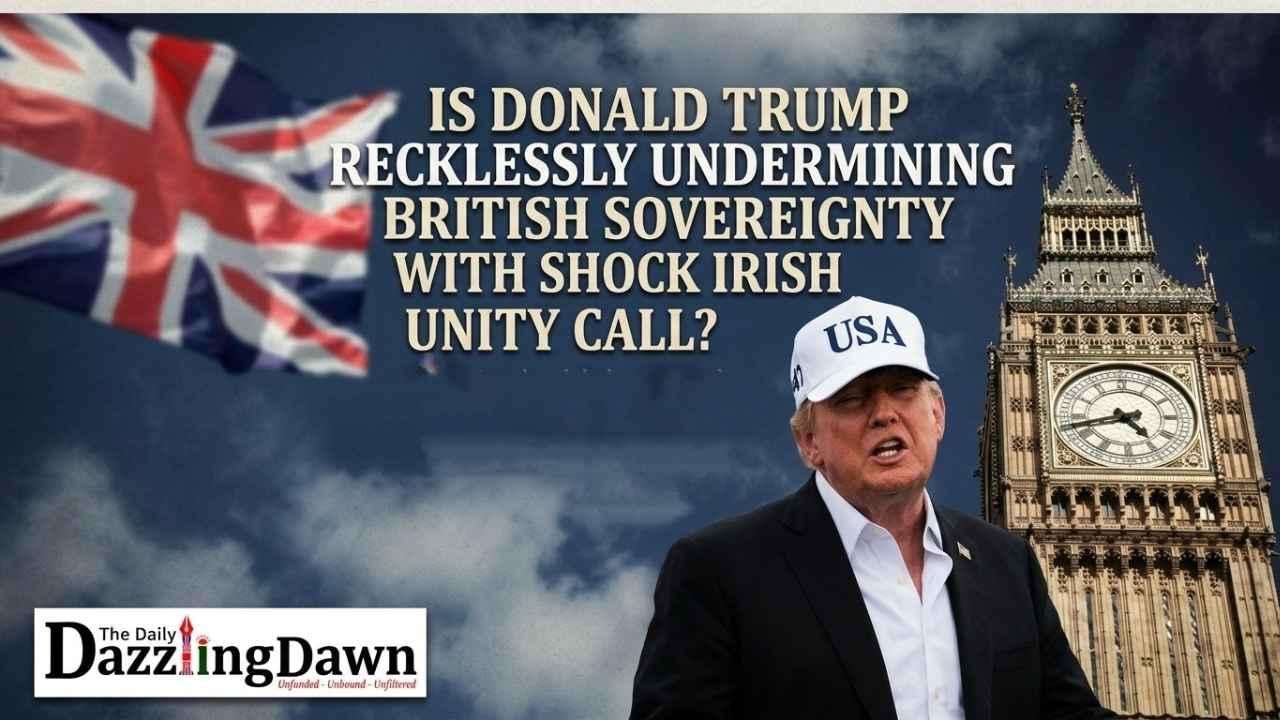
Donald Trump has provoked deep political fury across the United Kingdom after brazenly advocating the partition of the Union and the reunification of Ireland during a weekend visit to County Clare. Speaking at his golf resort in Doonbeg on Sunday, 13 September 2026, the United States president doubled down on incendiary remarks first delivered alongside Taoiseach Micheál Martin in Dublin, declaring that merging Northern Ireland into the Republic is natural and inevitable. Daily Dazzling Dawn understands that senior figures across Westminster and Belfast view the intervention as an intolerable breach of international protocol and an affront to British national sovereignty. Rather than respecting the delicate diplomatic balance that has safeguarded peace in Northern Ireland for nearly three decades, the American president dismissed grave constitutional realities with cavalier banter, telling journalists that he loved the hostile reaction his statements had provoked.
The controversy began when Mr Trump addressed reporters at Farmleigh House in Dublin, claiming Irish unification would be a fantastic thing before asking how such an outcome could possibly be bad. He followed those remarks with further comments describing the dismantling of the United Kingdom as very cool, blatantly ignoring the settled democratic will of British citizens living in Northern Ireland. Asked whether Scotland should similarly pursue separation from the UK, the president refused to rule out future interventions, remarking that he would save that topic for another day. Democratic Unionist Party leader Gavin Robinson issued an immediate rebuff, making clear that the constitutional future of Northern Ireland will be determined exclusively by its own people rather than by transatlantic commentary. Reform UK treasury spokesman Robert Jenrick told broadcasters that the remarks were completely wrong, insisting that any British administration must defend Northern Ireland’s rightful place within the realm under the strict legal mechanisms of the 1998 Good Friday Agreement.
This latest diplomatic intrusion represents merely the newest chapter in a prolonged pattern of American political overreach into domestic British affairs. For years, Mr Trump has routinely targeted the United Kingdom's most cherished institutions and democratic leaders whenever it served his populist narrative. British citizens remember vividly his repeated attacks on the National Health Service, which he erroneously claimed was broken and later declared would be up for negotiation on the table during bilateral trade talks, provoking intense national indignation. He consistently undermined British prime ministers during delicate negotiations, publicly berating Theresa May’s Brexit stewardship in national newspapers while visiting her as an official guest. Furthermore, his recurring, ill-informed tirades against London’s governance and its elected mayor demonstrated a chronic refusal to observe standard diplomatic boundaries.
Under the statutory framework of the 1998 Belfast Agreement, a border poll can only ever be directed by the Secretary of State for Northern Ireland if evidence clearly indicates that a majority of the electorate desires constitutional change. Prime Minister Andy Burnham recently stated in the House of Commons that any border referendum remains firmly off the table, reiterating total adherence to the principle of consent. For an American leader to treat three decades of hard-won peace and constitutional stability as casual conversational material devalues the solemn sacrifices made by British citizens and security forces to secure peace across the British Isles. British sovereignty is neither a bargaining chip for American trade negotiators nor casual fodder for foreign golf resort press conferences.

.jpg)


.jpeg)