






.svg)
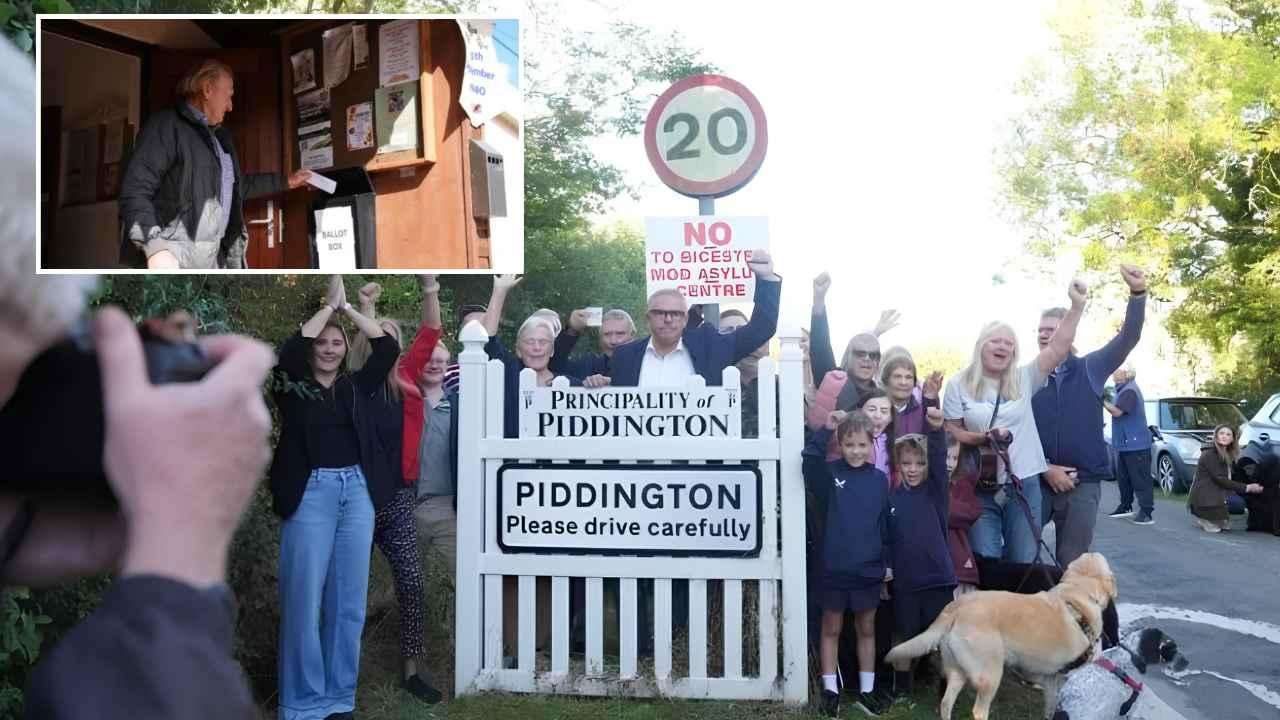
Residents of Piddington in Oxfordshire have voted overwhelmingly to symbolically leave the United Kingdom, protesting plans to house up to 1,256 male asylum seekers at a former Ministry of Defence site near Bicester.
The symbolic referendum was held on Tuesday, 15 September, after the Home Office proposed using the MoD Bicester site, known as Site A, for asylum accommodation. Of 312 votes cast by residents, 285 supported leaving the UK, 26 voted against and one ballot paper was spoiled. The result was announced on Wednesday.
The vote has no constitutional or legal effect. Instead, organisers used the referendum to demonstrate the strength of local opposition while a formal government consultation on the proposed development remains open.
Piddington is a small village with around 350 residents, making the turnout particularly significant for the local campaign. Ballots were cast at the village hall, which serves as an important community hub.
The referendum was organised by the local parish council. Following the result, parish council vice-chair Susannah Parden described Piddington as “the village that roars”, while council chair Tim McNally said the vote demonstrated what he described as democracy in operation.
Local resident Herbert Owen also took part in the ballot and compared the protest to what he called the “Battle of Britain”.
The campaign has centred not only on the proposed number of asylum seekers but also on concerns about the suitability of the site and the way the decision was made.
Oxfordshire County Council leader Tim Bearder said the referendum demonstrated how strongly residents felt about the proposal. He also argued that the dispute concerned the government's engagement with the local community and questions about whether the former military site was suitable.
The government has defended its wider approach by pointing to the pressure created by the UK's asylum accommodation system and the need to reduce reliance on hotels.
Culture Secretary Lisa Nandy acknowledged that changes affecting communities could be distressing but said the government had inherited a substantial asylum backlog. She said ministers were processing claims more quickly and removing people who did not have the right to remain in the UK.
Nandy also said the government had obligations to provide accommodation for people seeking safety while the asylum system was being addressed.
The government's position comes amid a broader effort to move asylum seekers out of hotel accommodation and into other forms of temporary accommodation.
The Piddington dispute therefore reflects a wider national debate over where asylum accommodation should be provided, how communities are consulted and how the government balances local concerns with its responsibilities towards people seeking asylum.
The Home Office announced the Bicester proposal in June as part of wider plans to reduce the use of hotels for asylum accommodation.
Site A is located at the former Ministry of Defence estate between Piddington and the settlements of Upper and Lower Arncott. The location has previously been considered for asylum accommodation.
A similar proposal was made in 2005 but was subsequently abandoned by the then Labour government.
The latest plans prompted criticism from local representatives and organisations, with residents raising concerns about the scale of the proposed accommodation and the suitability of the location.
The area's Liberal Democrat MP, Calum Miller, has previously criticised the consultation process and said residents had not been given sufficient opportunity to participate in decisions that could have significant consequences for the surrounding communities.
The government has since published an Urgent Crown Development application relating to the proposal.
The symbolic referendum comes as the formal process moves towards an important deadline.
The public consultation on the government's plans is due to close at midnight on Thursday, 17 September. The referendum itself does not determine whether the asylum accommodation will proceed; that decision remains within the relevant planning and government processes.
For Piddington residents, however, the vote has provided a highly visible way of expressing opposition to the proposal.
Daily Dazzling Dawn understands that the central dispute now moves back to the formal consultation process, where representations concerning the proposed development can be considered alongside the government's application.
The outcome has also attracted national attention because of the unusual nature of the protest. Rather than simply holding a conventional local demonstration, residents used the language and symbolism of independence to underline their opposition to a national policy being implemented in their area.
For now, Piddington remains part of the United Kingdom, and the referendum has no legal power to change that. Its significance lies instead in the strength of the message delivered by residents as the government considers the future of the Bicester site.