






.svg)
Unregulated practitioners are exploiting an enduring loophole in British law to carry out invasive cosmetic operations from residential properties, leaving patients with life-altering disfigurements and transferring substantial corrective care costs onto the National Health Service. In suburban Manchester, an untrained practitioner operating under the name Luyen Vu has conducted cut-price blepharoplasties and facelifts from private terraced houses for hundreds of pounds in cash. Under current United Kingdom legislation, individuals without healthcare training may legally perform surgical incisions provided they do not fraudulently adopt protected professional titles such as medical doctor or registered plastic surgeon. The continued proliferation of these domestic clinics highlights critical enforcement failures across regulatory bodies, despite repeated ministerial pledges to close legislative gaps governing invasive aesthetic treatments.
The Manchester Residential Operation
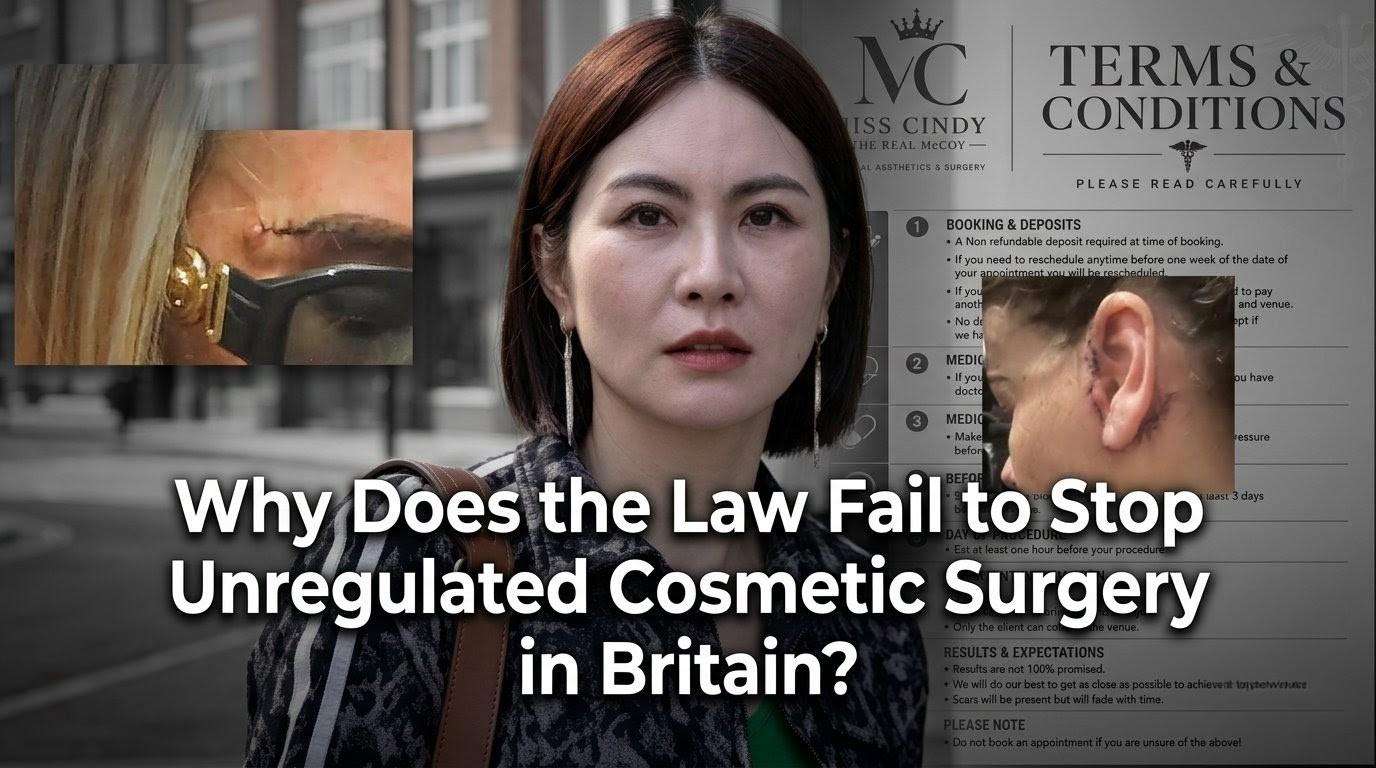
The scale of the underground cosmetic sector became evident during surveillance of a residential address near Manchester's canal quarter, where multiple clients arrived at staggered hourly intervals following encrypted coordination. Daily Dazzling Dawn understands that patients paid approximately £850 in physical currency for upper and lower eyelid alterations, known medically as blepharoplasties, alongside surgical facelifts advertised at up to £1,800. These figures represent a fraction of the £2,000 to £6,000 fees typically charged by regulated private hospitals across England. Those emerging from the domestic property displayed visible facial trauma, with thick, asymmetrical sutures placed around the brows and eyelids, partially concealed beneath dark eyewear.
The practitioner responsible, identified across promotional aesthetic networks as Luyen Vu, or the alias Miss Cindy, has operated without verifiable medical registration, clinical insurance, or formal surgical accreditation. Inquiries confirmed that Vu previously conducted similar eyelid procedures from an unsterile flat above a commercial restaurant in Liverpool before relocating her enterprise across the North West to evade detection. Clients attending the suburban Manchester venue confirmed they received no preliminary clinical assessments, allergy screenings, or comprehensive medical history evaluations prior to undergoing scalpel incisions.
Subcontracted Promotion and Digital Facilitation
The enterprise relied on structured commercial partnerships with established high-street beauty entities to secure prospective clients across social platforms. In Manchester, aesthetic practitioner Cheryl Hogan promoted Vu's surgical services via her brand Fleek Aesthetics, distributing social marketing materials that explicitly dismissed formal qualifications while championing cut-price facial restructuring. Promotional materials assured prospective clients of sterile operating conditions and full prescription aftercare, despite neither individual holding statutory prescribing authority within the United Kingdom.
Other victims confirmed their appointments were arranged through intermediary bodies such as The Clinic Club, an agency linked to banned aesthetic providers in London and Hertfordshire. Daily Dazzling Dawn learned that patients seeking post-operative support following acute swelling, asymmetry, and persistent wound pain found their contact channels permanently severed. Patients reported being supplied with unlabelled oral medication and topical anaesthetic creams bearing non-English labelling, pointing to systemic breaches in the domestic supply of prescription-only pharmaceutical products.
Clinical Perils of Unregulated Eyelid Surgery
The physiological consequences of performing delicate oculoplastic surgery outside sterile medical environments remain severe. Consultant ophthalmic and oculoplastic surgeons have warned that eyelid procedures involve critical margins of error where the excision of excessive dermal tissue permanently prevents natural eyelid closure. This condition, termed lagophthalmos, leaves the exposed cornea vulnerable to chronic abrasion, intractable infection, and irreversible visual impairment.
Specialists noted that several patients underwent modified sub-brow skin excisions, an intervention requiring deep anatomical understanding of varied tissue densities across different ethnicities. When conducted incorrectly in domestic environments, the resulting tension causes severe hypertrophic scarring and permanent facial nerve damage. Patient advocacy organisations, including Save Face, confirmed that multiple women have been left unable to sleep without manually taping their eyelids shut, with several victims receiving clinical evaluations classifying the procedures as physical assaults.
Statutory Inertia and Mounting NHS Burdens
The ongoing operation of backstreet surgical providers exposes an institutional disconnect between governmental rhetoric and legislative action. While the Health and Care Act 2022 granted statutory powers to establish a comprehensive licensing framework for non-surgical cosmetic interventions in England, primary legislation has yet to outlaw invasive surgical incisions carried out by laypersons who avoid claiming protected medical designations. Campaigners have consistently cautioned that standard police constabularies remain reluctant to apply criminal assault statutes to elective procedures where clients ostensibly consented, even when carried out under fraudulent assertions of clinical sterility.
Senior surgical figures, including former NHS England medical directors and representatives from the Royal College of Surgeons of England, have formally petitioned the Department of Health and Social Care to enact immediate bans on high-harm aesthetic procedures performed by non-healthcare professionals. Corrective treatments for necrotic tissue, sepsis, and structural reconstruction continue to fall upon regional NHS trusts, leaving public resources to address complications generated by commercial enterprises operating entirely outside statutory oversight.