







.svg)
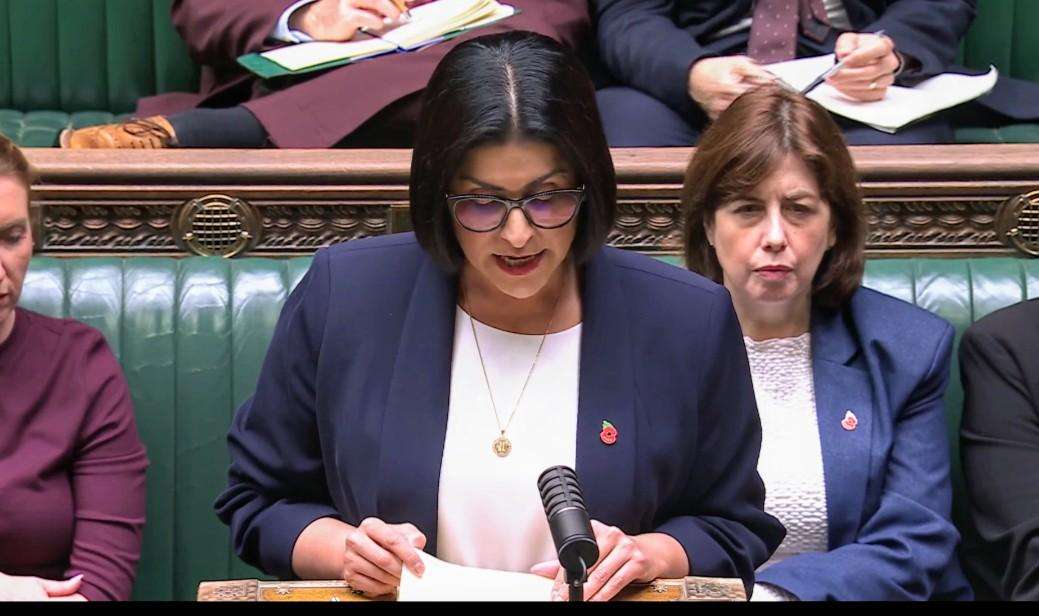
Home Secretary Shabana Mahmood will deliver a formal ministerial statement to the House of Commons in Westminster after 3.30pm on Monday, 2 November 2026, setting out revised qualifying rules for Indefinite Leave to Remain (ILR) across the United Kingdom. While Conservative Shadow Home Secretary Chris Philp and Reform UK leader Nigel Farage accuse the Home Secretary of executing a policy U-turn by exempting existing overseas social care workers from retrospective settlement delays, a special analysis by Daily Dazzling Dawn indicates she is executing a calibrated tactical concession rather than a full reversal. Beyond fiscal pressures, Prime Minister Andy Burnham and Shabana Mahmood confront their most acute political dilemma yet, as right-wing opposition figures elevate the settlement debate into Britain's primary national controversy to exploit internal Labour Party divisions.
The current political confrontation stems from initial proposals unveiled by the Home Office in November 2025. Under those original measures, the government sought to double the standard qualifying residency period for Indefinite Leave to Remain from five years to ten years for most legal migrants, while extending the threshold to fifteen years for overseas social care workers. Crucially, the November 2025 blueprint proposed applying these extended timelines retrospectively to foreign nationals already working in Britain.
Following a year-long public consultation that generated more than 200,000 responses, Daily Dazzling Dawn understands that the Home Secretary will retain the overarching ten-year settlement framework for future arrivals while exempting social care staff already residing in the United Kingdom from retrospective delays. Because these adjustments to immigration rules do not require primary legislation, the government will implement the changes without a formal parliamentary vote or the possibility of backbench amendments in the House of Commons.
Special analysis by Daily Dazzling Dawn confirms that while opposition parties frame today's announcement as a total capitulation, the Home Secretary is actually Ring-fencing the core architecture of her border reforms. Rather than abandoning the tougher settlement regime entirely, Mahmood has separated retrospective application for existing care staff from the broader ten-year qualifying mandate, which will still govern hundreds of thousands of legal migrants.
This calculated adjustment resolves a major cabinet dispute that threatened governmental unity. Housing Secretary Angela Rayner previously criticised the prospect of applying settlement rules retrospectively, describing the backdating of qualifying periods for workers already in Britain as "un-British" in comments told to journalists. Former Energy Secretary Miatta Fahnbulleh similarly declined to endorse the prolonged timetable, while more than 100 Labour Members of Parliament expressed serious reservations regarding the fairness of altering visa terms mid-stream. Prime Minister Andy Burnham, currently travelling via Manchester and Canada to the Commonwealth Heads of Government Meeting in Antigua, had also argued internally for more sympathetic treatment of care sector personnel while maintaining that permanent settlement remains a status that must be earned.
Why Right-Wing Politicians Frame Settlement as a National Crisis-
For Prime Minister Andy Burnham and Shabana Mahmood, the controversy surrounding Indefinite Leave to Remain represents a political challenge that far outweighs immediate fiscal calculations. Right-wing politicians across the Conservative Party and Reform UK have strategically positioned legal settlement and permanent residency as the defining crisis in British politics, using the issue to challenge the government's electoral mandate and fracture Labour's electoral coalition.
The central driver behind this opposition strategy is the approaching five-year settlement eligibility window for the large cohort of legal migrants who entered Britain between 2021 and 2024 under previous Conservative administrations—a demographic surge Mahmood previously termed the "Boriswave". In March 2026, the Home Secretary noted that without intervention, approximately 350,000 low-wage workers and their dependants on health and social care visas would qualify for permanent settlement and state benefits over the coming five years, carrying an estimated lifetime taxpayer cost of £10 billion according to Migration Advisory Committee projections.
With recent Office for Budget Responsibility (OBR) data confirming that headline net migration is now falling rapidly and Reform UK's previous ten-point polling lead receding, opposition leaders have pivoted from border entry figures to permanent residency costs. Shadow Home Secretary Chris Philp stated to journalists via social media that Mahmood had surrendered control of immigration policy to Angela Rayner and the Labour left, arguing that the Conservative Party supports a strict ten-year route restricted exclusively to high-wage workers while requiring existing low-wage visa holders to depart upon visa expiry. Simultaneously, Reform UK leader Nigel Farage argued that the cabinet lacks a public mandate to grant permanent settlement, while Reform UK Treasury spokesperson Robert Jenrick claimed that granting citizenship to 400,000 arrivals after six years would cost taxpayers hundreds of billions of pounds.
The disconnect between Westminster political rhetoric and domestic economic reality has placed the Labour administration in an exceptionally delicate position. Speaking to journalists for an ITV broadcast, Prime Minister Andy Burnham declined to characterise current legal net migration as excessively high, contrasting sharply with the rhetoric of his predecessor, Keir Starmer. While acknowledging that small boat crossings in the English Channel remain too high, Burnham observed that planned legal migration has decreased substantially and must be calibrated to address structural labour shortages within the British economy.
Meanwhile, trade union leaders continue to challenge the government's characterisation of the overseas workforce ahead of scheduled talks at the Home Office today. Unison General Secretary Andrea Egan, who represents thousands of social care employees, criticised the original fifteen-year waiting period and objected after Home Office officials declined to permit a Nigerian care worker named Kolade to attend today's ministerial meeting. Daily Dazzling Dawn learned that Kolade intended to challenge the political portrayal of care staff as an economic burden, noting in remarks told to journalists that migrant carers actively support British families and contribute directly to the national economy. As Danny Kruger of Reform UK prepares to address the Policy Exchange thinktank at 12.30pm and Angela Rayner answers departmental questions in the Commons at 2.30pm, Mahmood's afternoon statement will test whether her calibrated concession can neutralise right-wing political attacks without igniting a wider rebellion across the Labour backbenches.




.jpg)