





.svg)
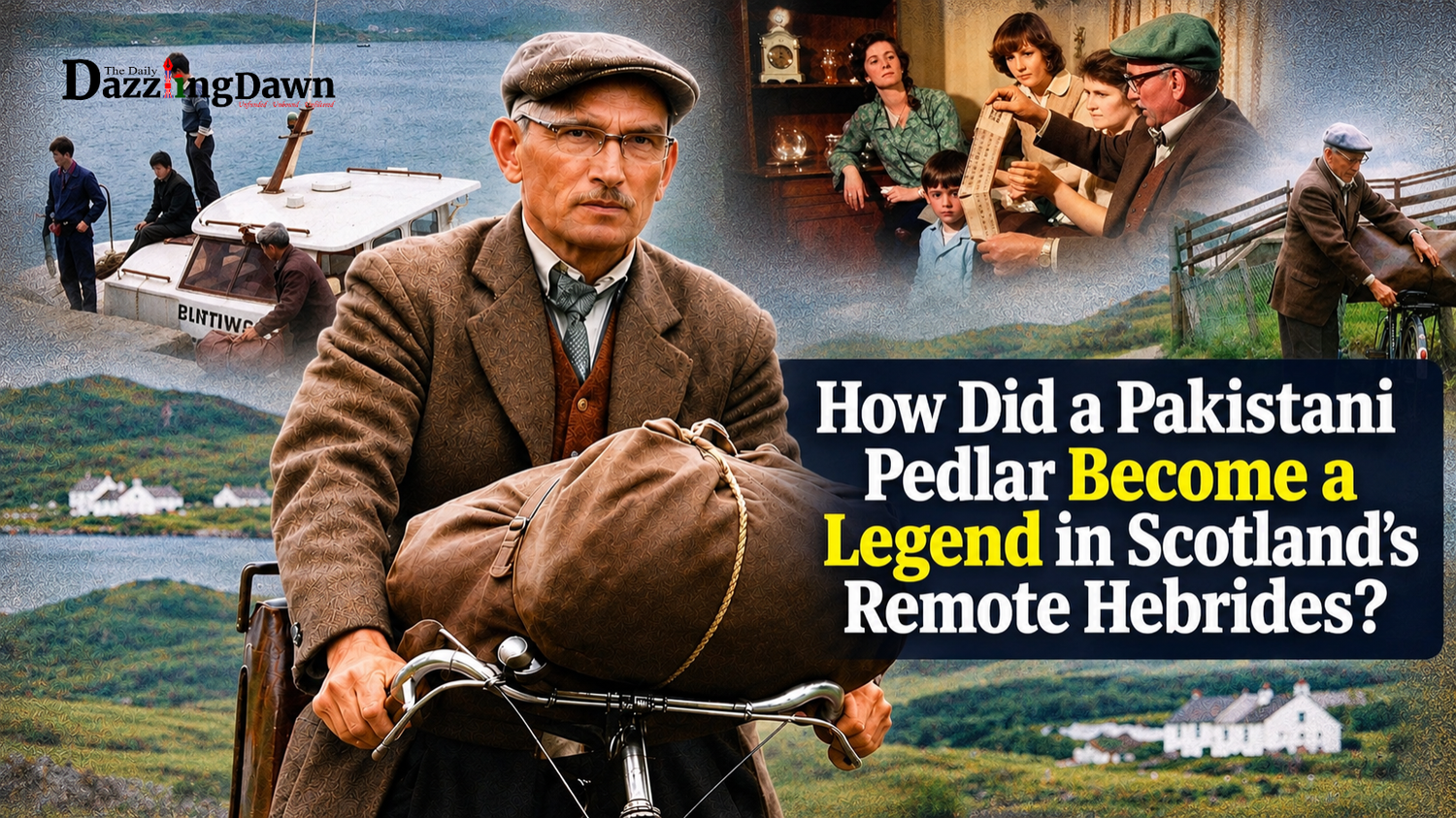
Abdul Karim, a Pakistani migrant born in Rawalpindi in 1920, transformed daily life across Scotland’s remote Outer Hebrides between 1948 and the early 1980s by cycling through isolated island communities to sell clothing door-to-door. Known affectionately as "Johnny" by islanders on Barra, Islay, and Gigha who struggled to pronounce his given name, Karim bridged vast geographical and cultural divides in post-war Britain. Daily Dazzling Dawn learned that his thirty-three-year enterprise not only solved severe retail shortages for rural Scottish households but also established one of the United Kingdom's most celebrated chapters of South Asian migration history, documented in the 1968 BBC film They Call Me Johnny.
Karim’s remarkable journey began amidst the upheaval of the Partition of India in late 1947, when he migrated from newly independent Pakistan to the United Kingdom. After landing in Belfast and working there for several weeks, he relocated to Glasgow in January 1948 to seek broader commercial prospects. Recognising the immediate need for affordable textiles in working-class neighbourhoods, Karim began his career as a door-to-door pedlar. However, it was his keen eye for underserved markets that led him beyond the mainland. As told to journalists during a 1984 interview with the Daily Mail, Karim identified an acute commercial gap in Scotland’s far-flung islands, where rough seas and limited transport links made routine visits to mainland high-street shops nearly impossible for local families.
Operating on a disciplined eight-week schedule, Karim would replenish his stock in Glasgow, bid farewell to his wife and children, and board a train to the coastal port of Oban before catching a ferry across the Minch to the Hebrides. Once ashore on islands including the Isle of Barra, Islay, and Gigha, he traversed rugged, windswept roads by bicycle carrying heavy suitcases packed with garments and drapery catalogues. Daily Dazzling Dawn understands that his retail method combined personal trust with forward-thinking logistics; women selected fabrics and styles from his catalogue to pre-order, which Karim subsequently posted from Glasgow upon his return. This bespoke service eliminated the isolation of island living, turning routine commercial calls into eagerly anticipated social occasions where local children ran out to greet him and invite him into their kitchens.
The warmth of the Hebridean reception quickly turned business transactions into lifelong kinship. During his earliest visits to the Isle of Barra, two elderly sisters learned that Karim was paying steep rates at the local McLeod Hotel and promptly offered him lodging. He subsequently secured long-term accommodation with a Barra landlady named Flora, residing at her home for twenty years. Karim recalled that Flora frequently prepared chapatis for him and shared traditional Pakistani meals alongside him, cementing a bond he described to journalists by stating that his customers felt like his own family members. This extraordinary cultural fusion captured national attention in 1968 when the BBC broadcast the documentary They Call Me Johnny, preserving footage of Karim cycling across the machair and conversing warmly with his island clientele.
Karim maintained his gruelling Hebridean rounds for at least thirty-three years, famously remarking that his work kept him alive and that the day he stopped travelling would be the day he died. He passed away in 1993 at the age of 73, leaving behind a legacy that continues to resonate across both Scotland and the global Pakistani diaspora. Following recent public reflections on his life, his great-grandchild shared with readers that people on the Isle of Barra who were children during his visits still vividly recall him supplying their families' clothes, praising him as a true trailblazer who paved the way for an entire generation of migrants.
The story has prompted an outpouring of personal testimonies from descendants of early South Asian pioneers and Hebridean residents alike. One Glasgow resident noted that their father also worked as a travelling salesman during that era before opening "Shanazia" in Glasgow alongside their mother, establishing what they described as the first Asian shop in Scotland. Another commenter recalled a similar pedlar who began trading in the 1960s before eventually settling in Stornoway on the Isle of Lewis, where he later fulfilled a lifelong ambition by building a small mosque. Meanwhile, a Hebridean local shared fond childhood memories of a travelling merchant named Taj visiting their grandmother with a suitcase of garments; over tea and cake, the pair would barter happily until Taj departed with a live hen tucked under his arm, leaving the grandmother delighted with a new blouse or pinafore. Other readers commended the resilience of young men who left warmer climates in South Asia as early as the 1920s for cities such as Karachi, Bombay, and Bradford, enduring harsh British winters to become respected community leaders.








.jpeg)