






.svg)
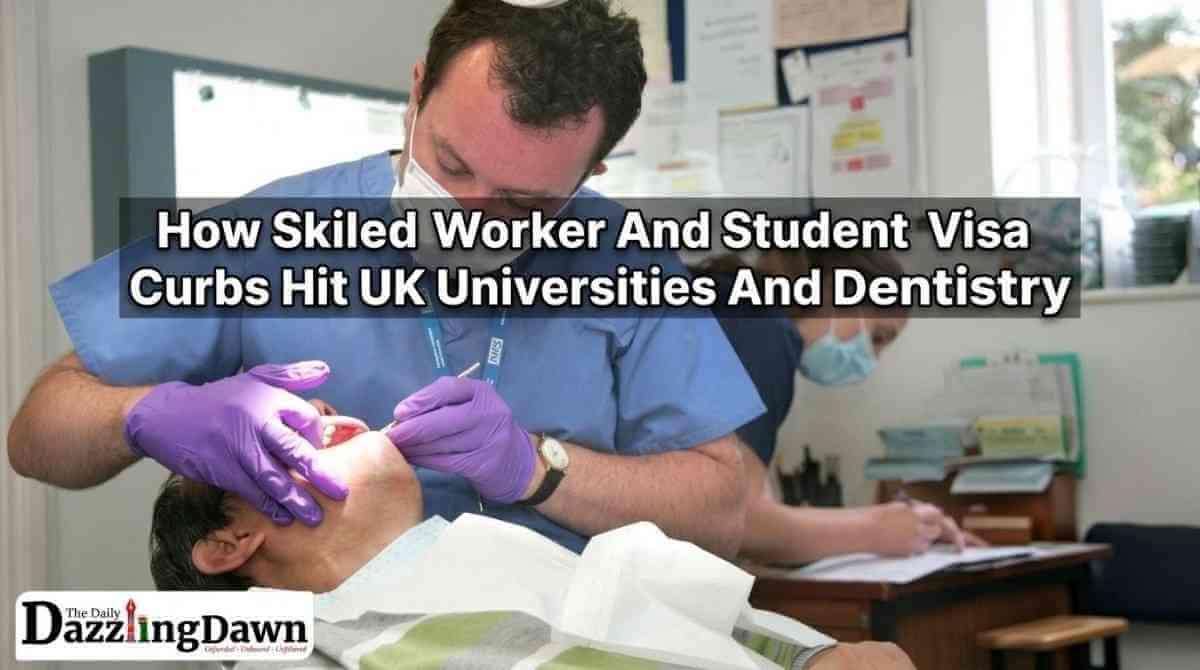
Sweeping immigration curbs across the United Kingdom are driving severe operational contractions across tertiary education and clinical dentistry, according to official Home Office datasets released on 14 September 2026. Exactly twelve months after Whitehall raised the Skilled Worker qualification threshold to Regulated Qualifications Framework (RQF) Level 6 on 22 July 2025, sponsored entry-clearance grants for overseas dental nurses collapsed by 95 per cent, falling from 122 approvals to just six between late 2025 and mid-2026. At the same time, peak-season applications for sponsored study visas plunged by 16 per cent in August 2026 compared to August 2025, intensifying insolvency fears across tuition-dependent institutions. Higher education leaders and primary care dental providers now view the combined fallout as an existential risk to regional campus solvency and routine patient provision.
University Solvency Pressures Mount Amid Recruitment Slump-The decline in study visa applications strikes at the core of British university finances during August, the traditional peak window for international enrolments. Sector analysts attribute the drop directly to the 2023 restrictions that barred most international postgraduate students from bringing dependants, compounded by escalating UK living costs and the looming imposition of an international student levy. While net migration to the UK fell to 171,000 in 2025—down 48 per cent from the post-Brexit peak of 944,000 recorded in March 2023—academics caution that treating international students as net migration statistics creates profound structural damage. Oxford Brookes University modern history professor Glen O’Hara warned that vulnerable institutions will soon hear the footsteps of their creditors outside, while University of Birmingham migration specialist Professor Jenny Phillimore observed that several institutions may go under because overseas student fees fundamentally subsidise domestic tuition shortfalls and research budgets.
Higher Education Policy Institute director Nick Hillman cautioned against outright panic due to shifting international decision-making patterns, yet expressed concern that incoming Whitehall ministers, including Education Secretary Lucy Powell and Science Minister Chris McDonald, might fail to grasp that international recruitment generates the primary operational surplus in British higher education. Furthermore, Birkbeck, University of London vice-chancellor Sally Wheeler pointed out that while expanding domestic university capacity abroad and international English-language programmes dilute demand, the current drop is overwhelmingly driven by government policy settings that weaken British soft power. Although international education champion Sir Steve Smith argued that universities will simply downsize rather than shutter completely, institutional heads report that competing destinations like Australia, Canada, and the United States are also tightening rules while fiercely contesting the remaining global talent pool.
Skilled Worker Reforms Paralyse Dental Team Recruitment- A parallel emergency is unfolding across the British dental sector following the July 2025 overhaul that raised the general Skilled Worker qualification baseline to graduate degree equivalence (RQF Level 6) while raising standard salary thresholds from £38,700 to £41,700. Under the restructured rules, dentists and dental therapists retain eligibility for sponsorship under the Health and Care Worker route after the Department of Health and Social Care clarified occupation codes. However, dental nurses (SOC 6133), dental hygienists, and dental technicians (SOC 3213) were excluded from both the Immigration Salary List and the Temporary Shortage List, cutting off new overseas hiring channels and stripping the sector of the former 20% salary discount. Consequently, overseas dental nurse visa issuances fell by 95 per cent over the initial three comparative quarters, severing a critical career bridge often used by overseas-trained dentists working as nurses while preparing for UK licensing.
Although the General Dental Council register recorded 69,824 dental nurses, 11,407 dental hygienists, and 8,824 dental therapists on 17 August 2026, healthcare providers emphasise that headcount numbers fail to reflect actual clinical chairside capacity or geographic workforce distribution. Fiona Ellwood, executive director of the Society of British Dental Nurses, expressed frustration that experienced dental nurses are deemed ineligible under current Skilled Worker definitions. Concurrently, Shushaanth Sounthararajan of Dentartistry told reporters that practices have lost their primary staffing pipeline, while The Dental Design Studio clinical director Jeff Sherer warned that soaring sponsorship thresholds have made overseas recruitment financially impossible. Sherer proposed that businesses paying visa sponsorship fees should receive rebates in return for delivering contracted National Health Service care in critically underserved areas.
Rising Regulatory Hurdles And Sponsor Enforcement Risks- International dental graduates preparing for domestic practice face compounding financial and administrative roadblocks. Under rules introduced in March 2023, foreign dental qualifications alone cannot be used to register as a dental care professional without completing the Overseas Registration Examination (ORE). Although General Dental Council testing capacity has broadened under a revised contract, examination spaces remain intensely oversubscribed, while the Overseas Registration Examination Part 2 fee climbed by 65 per cent to £6,967 for 2026/27. When paired with April 2026 fee increases for Home Office sponsor licences and the Immigration Skills Charge—which stands at £480 for small businesses and £1,320 for medium-to-large sponsors—independent dental practices are increasingly priced out of international hiring.
At the same time, sponsor compliance penalties have escalated. UK Visas and Immigration (UKVI) now mandates real-time address verification, strict rota monitoring, and immediate absence notifications, penalising minor errors with immediate licence action. The vulnerability of clinical providers was highlighted by Damira Dental Group, whose sponsor licence was suspended after a four-hour inspection, leaving roughly 130 sponsored overseas staff in limbo until the group compiled roughly 1,000 compliance documents in seven days to secure reinstatement. As Downing Street maintains its strict migration baseline under Prime Minister Andy Burnham and Home Secretary Shabana Mahmood, university vice-chancellors and dental clinical directors are mounting joint representations to HM Treasury, cautioning that without surgical carve-outs for student levies and clinical auxiliaries, frontline dental treatment backlogs and campus restructuring will accelerate nationwide.








.jpg)