






.svg)
California Governor Gavin Newsom has officially signed Assembly Bill 2017 into law, formally establishing Eid al-Fitr and Eid al-Adha as recognised state holidays across the most populous jurisdiction in the United States. The enactment establishes California as only the second US state to take this statutory step following Washington state’s legislative decision in 2025. Authored by Assemblymember Matt Haney and co-sponsored by the Council on American-Islamic Relations California alongside the California Commission on Asian and Pacific Islander American Affairs and the Muslim Impact Council, the measure introduces structural protections rather than blanket workplace closures. The law explicitly permits state workers and school staff to utilise accrued personal leave credits to observe both holy days, whilst empowering K-12 school districts and community colleges to implement campus closures via locally negotiated agreements. Daily Dazzling Dawn understands that the legal framework resolves a persistent civic challenge for California’s estimated one million Muslim citizens—who make up approximately 2.5 per cent of the state’s 39 million residents—eliminating the historic dilemma of choosing between academic or workplace obligations and mandatory religious worship.
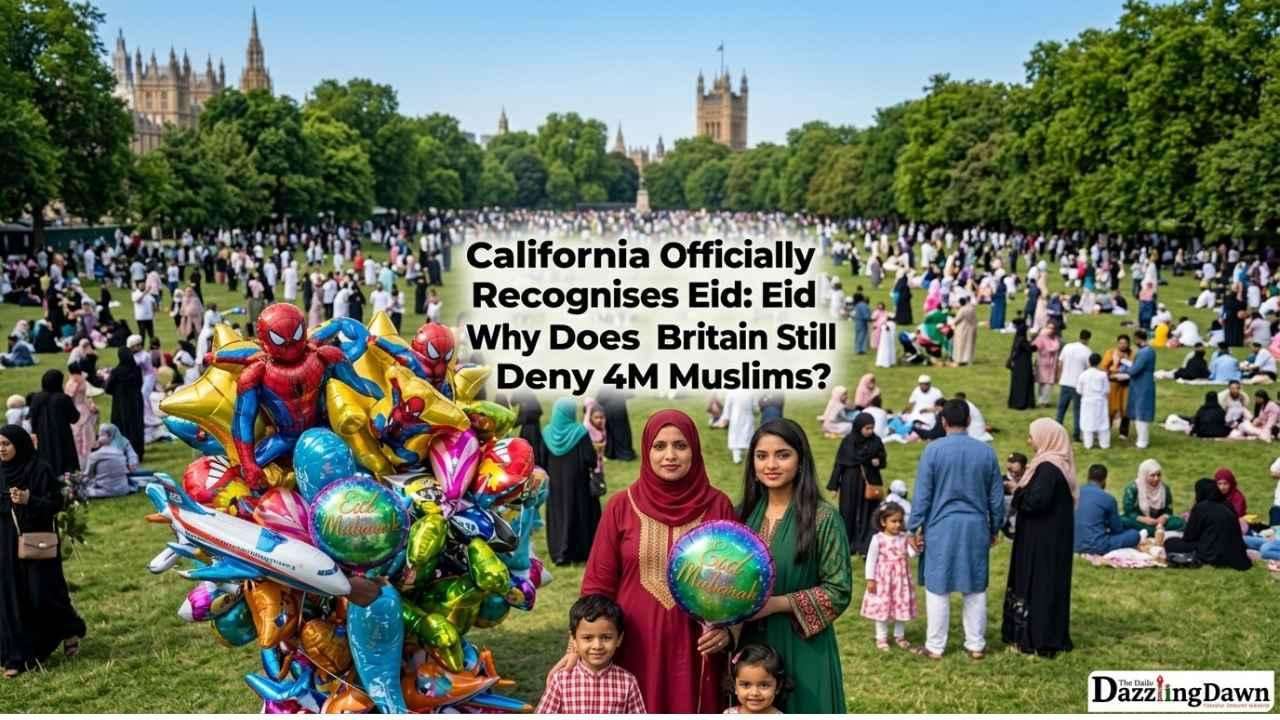
The landmark achievement in Sacramento has ignited immediate friction across the Atlantic, casting an uncomfortable light on the unyielding civic calendar of the United Kingdom. According to official data from the Office for National Statistics, England and Wales alone record approximately 3.9 million Muslims, comprising 6.5 per cent of the total population, with nationwide United Kingdom estimates easily exceeding four million. In sheer demographic presence, British Muslims represent nearly three times the population percentage of their Californian counterparts, standing as the second-largest faith cohort in the nation. Yet despite decades of deep community integration, British Muslims do not possess a single statutory bank holiday or institutional legal guarantee acknowledging their sacred calendar. While California now integrates both Eids alongside Lunar New Year and Diwali within its official state lexicon, Westminster continues to enforce a rigid holiday architecture that exclusively privileges historic Christian and secular civic fixtures.
For more than twenty years, British Muslim organisations, grassroots collectives, and civic campaigners have lodged official appeals and parliamentary petitions requesting public holiday recognition for Eid al-Fitr and Eid al-Adha. Multiple petitions exceeding the strict 100,000-signature threshold have landed on the desks of successive governments, only to encounter routine and decisive ministerial rejections. The established rebuttal from Whitehall, upheld consistently by successive Conservative and Labour governments, claims that the current eight-day statutory bank holiday framework in England and Wales cannot be altered due to severe economic fallout. Treasury and business department assessments routinely project that each additional national bank holiday costs the domestic economy billions in lost productivity, effectively shifting the civic and financial burden onto individual Muslim workers who must use limited annual leave or take unauthorised absences to fulfill foundational faith obligations.
Daily Dazzling Dawn learned that British legal analysts, trade unions, and faith advocates are scrutinising the precise architecture of California’s Assembly Bill 2017 to completely reshape their strategy in Westminster. Civil rights advocates note that California sidestepped traditional business lobby resistance by structuring the policy as a statutory accommodation framework rather than an economy-wide shutdown. For British campaigners, this pragmatic legal mechanism presents a viable blueprint: redirecting lobbying away from the outright creation of expensive general bank holidays and targeting structural amendments within the Employment Rights Act and the Department for Education’s attendance codes instead. By securing legally protected flexible leave rights for non-Christian major festivals and permitting academy trusts and local education authorities to align inset days with Islamic lunar dates, the UK could finally dismantle institutional barriers without incurring national productivity disruptions. With global democratic administrations modernising their civil codes to reflect multifaith realities, Westminster’s prolonged denial of statutory recognition to its four million Muslim residents faces an increasingly untenable future.